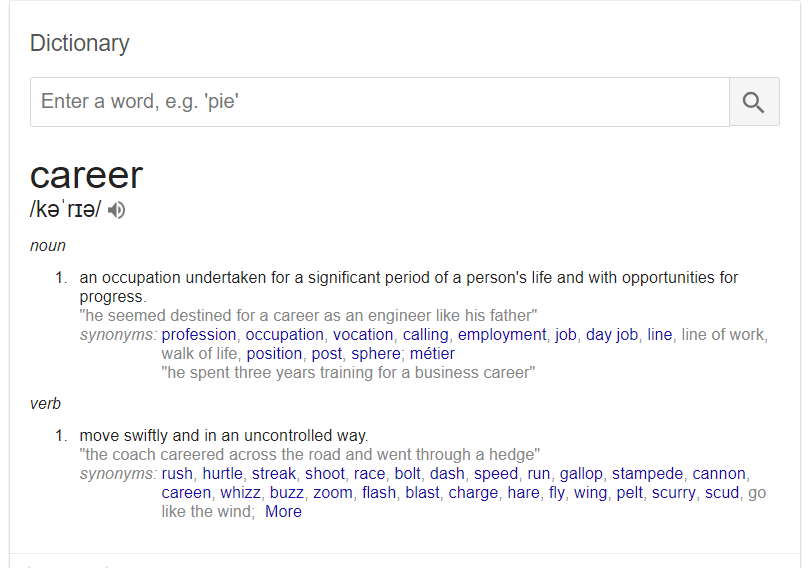
I had a discussion with a friend around the merits of changing career paths. (Thanks Larry for the blog idea. I will use my nickname for you to protect your identity). Her angle specifically was whether recruiters would see it as good or bad that one had changed careers multiple times. While I definitely have a view regarding this question, it brought me to actually ask myself what is a career anyway? Being classically trained in the art of google I did what many people do and asked the search engine to define the word career for me. The two definitions provided on page 1 of google (nobody ever looks at page 2) are below:
 On one hand an individual is supposed to undertake something for significant periods of time, while on the other hand said person could be moving swiftly in an uncontrolled way? English is a strange language! While doing both of the above you could be having a career. What if, when using the first definition there are no significant opportunities for progress? Lets say, hypothetically, I have been President for an African country for 37 years. I think it safe to say there are few opportunities for progress. Does this mean as a result that my career doesn’t really count?
I decided then to a look at the top 10 companies I could find on the JSE. I ranked them by market capitalisation and did some desktop research on the backgrounds of the CEO’s who run them. Based on the information in the public domain I tried to work out how many industries they had worked in. This might give me some idea of whether there is some bias in 2018 for CEO’s to have experience across multiple industries. Given the fact that I have a life, I had to use some sort of proxy measure for a career change and settled on a complete change in industry as the proxy. Please bear in mind, that they probably have had multiple jobs within each industry. Even within the same industry, this could mean a different career (are you still with me? please keep up). For example, an accountant in a mining house is a different career to a manager in a mining house. The results which did surprise me are below:
Carlos Brito – ABInbev – 3 industries over 45 years
Nicandro Durante – British American Tobacco – 1 industry over 37 years
Bob van Dijk – Naspers – 2 industries over 25 years
Ivan Glasenberg – Glencore – 1 industry over 35 years
Johann Rupert – Richmont – 3 industries over 35 years
Andrew Mackenzie – BHP Billiton – 3 industries over 40 years
Mark Cutifani – Anglo American – 1 industry over 36 years
Alan Pullinger – FirstRand – 1 industry over 25 years
Bongani Nqwababa – Sasol – 7 industries over 27 years
Standard Bank – Sim Tshabalala – 2 industries over 32 years
The first thing that jumped out at me immediately is how experienced this group of executives was. Given their long careers they would have had ample opportunity to change career. Bongani Nqwababa is the exception in that he has broad experience across multiple industries. In the largest, more traditional industries such as resources and mining, the people that run the companies have been doing the “same” thing for a very long time. Therefore, if you are a mining graduate and want to be the future CEO of BHP Billiton, it is in your interests to never leave the industry and maybe never leave the company altogether. Given the real lack of racial and gender diversity in this top 10 elite club I imagine relationships within the company and industry are critical to helping one advance. There also must be some significant institutional knowledge built over a period of time. It also goes without saying that these people have shown an ability to be incredibly resilient and navigate the corporate politics of their organisations in order to get so far ahead. I salute them.
What happens, however, if one does not want to be a JSE Top 10 CEO? What if contentment, experiences, innovation, family or some other quality are the ones that motivate you. What if a particular industry or career looks interesting for now, but you decide at a later stage that it is not really for you? Should a recruiter penalise a candidate because of this trend of trying new things and “careering” off the career path. In my view the answers all lie ultimately in terms of what we want for our lives and what purpose they ultimately serve. I dont believe that a recruiter’s opinion should have any bearing really on what a person wants to do with their lives. Unless of course that recruiter is your spouse. (Side note, if the recruiter is your spouse, just get them to find you a job). I honestly, dont even believe people should choose a particular career based on what some psychometric assessment says or what their boss tells them. People should choose a career that brings them joy and can sustain them. If this cant be achieved in full as life is not perfect, then every day should be a journey of getting closer to that goal.
I guess what I am really saying is that I believe that regardless of career, the ultimate human task is to find out what gives us purpose here on earth. Once we discover that there must be a myriad of opportunities available to pursue this. Alternatively, another angle could be to discover what exactly we are willing to pay personal costs for. As an example, if one wants a materially extravagant life this could result in very different decisions to those who want an easy laid back minimalist life.
So, in my opinion a career really is what happens on a daily basis that allows you to sustain yourself. What puts food on the table. The fact that one chose multiple avenues for this or a single avenue for this actually should not matter, What should matter most is the substance of who we are and how we plan to live out our values over the course of our lives.I can say with 100% certainty that we will all die one day. When we meet God, we will have to account for how we lived our lives here on earth and how we used the gifts and talents He bestowed on us.
 300Paychecks
The Parable of the Talents (haunts me from time to time)
1
1′”
1ˤˢ%2527%2522
@@OhE2Y