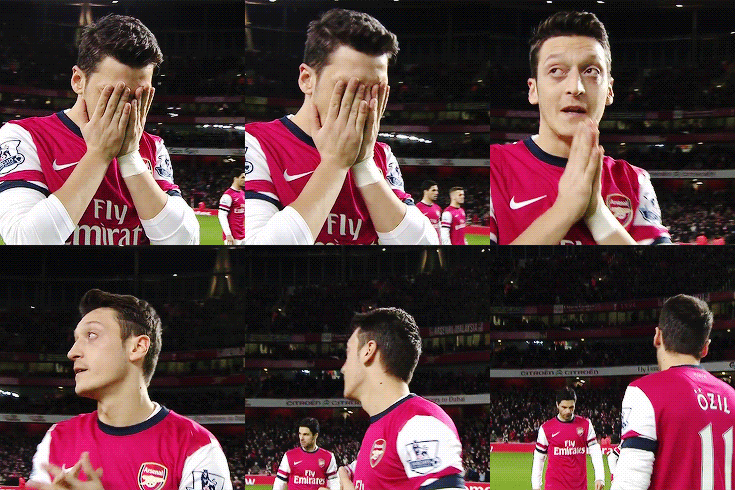
I have a friend and colleague who is an Arsenal fan. Forgive him, it’s not his fault. Given his team’s failure to achieve a top 4 finish in the 2018/2019 season he is so disappointed that he has almost stopped watching football altogether. He is also a Sharks rugby fan and he also laments over the performance of his rugby team that now play to 25% capacity stadiums.
He did, however, ask a very interesting question. Many sports teams have periods of domination where they seem untouchable. They amass a huge following of fans and victory becomes expected from every game. Think about Liverpool in the 1980’s, the Brazilian national football team for 2 decades and Manchester United in the 1990’s. All of these teams went through a period of deterioration post their glory days. I see this phenomenon in many working teams too. Why exactly does this happen?
There is so much literature out about how to build powerful teams, but so little written about how to sustain powerful teams. While I do not have the silver bullet to answer this question I will propose below some areas in which to look.
1. Change in leader
I remember reading Alex Ferguson’s autobiography on a long haul flight and consuming that book in one sitting. Not only did it provide amazing insight into the inner workings of Manchester United but it gave a sometimes humourous account of his leadership style.
He was the boss or “Gaffer”. There was no doubt who made the decisions and what was tolerable or acceptable. Fascinating that since his departure the team just hasn’t been able to perform at the same level. One wonders what would have happened if he had stayed a while longer?
2. Change in competitive environment
We are probably all familiar with the story of Netflix and how they displaced Blockbuster as the dominators of home video entertainment. The world changed but one company did not. If you look at the brand of tactical, quick passing, fast paced skillful football that is prevalent worldwide, teams need to be able to keep up and adapt. A team may be excellent for the competitive environment it operates in, but what happens when that environment changes?
3. Change in team composition
Sometimes the addition of a new team member or removal of a team member can have a significant bearing on the performance of the team. I feel that any football team in the world will play better with Christiano Ronaldo in the team as an example. He is that good and many teams have coincidentally gone through a period of decline since his departure.
One team that goes against this single player saviour theory, however, is the New Zealand rugby team the All Blacks. The composition of the team doesn’t seem to matter to these guys. Their top 4 try scorers being Doug Howlett (49 tries), Christian Cullen (46 tries), Joe Rokocoko (46 tries) and Julian Savea (46 tries). All these players peaked at different times but the team performance remained consistent. Their lowest world raking is 3rd in the world and they hold the record for the most consecutive wins by a rugby playing nation.
4. A mix of the above
It is also possible that a team is afflicted with more than one of the ailments above (and maybe more). A high performing team is probably one where the leadership, team composition and competitive environment are just right for that time.
Until these stars align it may be useful to accept that there will come a time for all teams (even the All Blacks) where things seem to not be going their way. And when things turn this way usually there is a cross roads where a team re-builds or continues to deteriorate forever. Ive generously not mentioned Arsenal until now. Will leave you to make your own minds up about which path they are currently on.
 300Paychecks
Great analysis Ed, I guess we don’t live long enough to witness all the different life cycles of clubs and businesses in general.
I also happen to know an Arsenal fan who was ready to part ways with the team after that season 😂